Protection for whistleblowers,
prosecution for gatekeepers
The ProPro Campaign: Protection for whistleblowers, Prosecution for gatekeepers
QUESTO ARTICOLO HA UNA VERSIONE IN ITALIANO

ESTE ARTÍCULO TIENE UNA VERSIÓN EN CASTELLANO

[Photo by Lance Reis on Unsplash]
A few days ago, in another article, I tried to take a cool-headed look at Trump's initiative to release documents on UFOs and UAP. Today I would like to step back and look at the bigger picture: what is really driving the Disclosure process forward? In my view, there are essentially two forces behind it. The first is political will. The second is the whistleblowers. And while a great deal is said about the first, far too little is said about the second, or at least not with the seriousness it deserves.
The first pillar: political will
The main "fuel" of the gradual Disclosure process now under way is the clear political will, expressed by the United States Congress on a bipartisan basis, to shed light on what certain components of the US government apparatus know and do about the UFO/UAP phenomenon. That is no small thing in a Congress divided on almost everything: on this issue, Republicans and Democrats have repeatedly found themselves on the same side.
And the stakes could not be higher. The question is whether, as a number of qualified witnesses now claim, these components of the government have long known that ETs exist and are present on Earth, very likely for a long time; whether they have recognized the enormous military potential of the technological objects that appear to be the manifestations of the phenomenon; and whether, for many decades, they have been running secret, unacknowledged programs to recover and reverse-engineer the craft that somehow come into their hands.
In this process of "shedding light", briefings, mostly behind closed doors, and public hearings play an important role. Just think of the hearings held in the House of Representatives on July 26, 2023, November 13, 2024 and September 9, 2025. But there is one element that gives these hearings their real impact: the people who testify at them.
The second pillar: the whistleblowers
The most important role of all, in fact, is played by people who come forward out of conscience to report facts they know about and that are deeply illegal. The point is not so much, or not only, that recovery and reverse-engineering programs exist: it is that these programs have allegedly been run for decades while deliberately keeping the bodies constitutionally responsible for overseeing them in the dark, starting with Congress. In a democracy this is no procedural detail: it is the very negation of democratic oversight.
These are the so-called whistleblowers, a word that has no real equivalent in Italian, which is why we Italians use it as it is. The best-known case is that of David Grusch, the former Air Force intelligence officer who testified under oath before Congress. But he is certainly not the only one: in The UAP Whistleblowers' Hall of Fame, which I curate on my website, you will find several others, including Luis Elizondo, Jeffrey Nuccetelli and, the latest addition, Dylan Borland.

The six whistleblowers featured so far in The UAP Whistleblowers' Hall of Fame (click on the image to visit it)
These people come forward purely out of conscience, and they invariably run into serious career problems, if not threats to their personal safety. Dylan Borland's story is emblematic: a former Air Force geospatial intelligence specialist, he told Congress that for more than a decade he suffered workplace retaliation and manipulation of his security clearance, until he found himself unemployed and with no prospects.
The reasons behind this intimidation and these career obstacles would deserve an article of their own, and I intend to write one. But one thing needs to be said right away, because it is fundamental: if someone goes to the trouble of threatening them, it means they are right. Nobody wastes energy intimidating people who tell tall tales. Retaliation is the unmistakable sign that these people have touched something real and concrete, and very likely also highly lucrative, above all for the defense companies involved in these programs.
Protect them, for real
That is why, after political will, the whistleblowers are the second pillar of the Disclosure process. And precisely for this reason they must be protected with concrete measures, not with words written on pieces of paper.
Let me be clear: I do not mean to belittle political will, which has no other way of expressing itself than through laws, that is, words written on paper. In recent years plenty of such words have been written, and some of them point in the right direction: last September, for example, the Pentagon formalized a waiver meant to protect those who come forward to speak with AARO or the PURSUE task force from prosecution and career retaliation. But laws are only worth as much as their enforcement. As long as those who testify keep losing their jobs, having their security clearances revoked or being discredited, protection will remain on paper. And as long as it remains on paper, other potential witnesses, who surely exist, will think twice before coming forward.
And the gatekeepers?
On the other side of the barricade are those who oppose Disclosure, and they do so out of specific interests: the profits of the large defense contractors, or the wish to cover up illegal, if not outright criminal, actions. They are the so-called gatekeepers: those who decide who may know and who may not, and who for decades have kept the gate firmly shut, Congress included.
My position on them is clear-cut: they deserve only to be held to account for their actions before the courts. With one exception, which I also consider a smart incentive: the possibility of an amnesty, but only for those who come forward right away and tell everything they know. Those who cooperate open the gate; those who keep it shut bear the consequences.
Protection, not amnesty
Lately some people have been talking about "amnesty for whistleblowers". The intention is certainly good, but the concept is wrong, and it is worth explaining why. An amnesty is an act of clemency that wipes out an offense: it is granted to those who have committed a crime. Calling for it for whistleblowers means, even unintentionally, accepting the idea that those who report wrongdoing are culprits in need of forgiveness.
But whistleblowers have committed no crime: they have reported one. Informing the congressional bodies lawfully responsible for oversight about programs that have been illegally kept hidden is not an offense, it is a civic duty. And it is exactly what whistleblower protection laws are supposed to guarantee.
The risk is a reversal of roles: if the idea of amnesty for those who come forward took hold, those who kept Congress in the dark for decades would still pass for the guardians of the law, while those who had the courage to speak out would carry the stigma of people who needed to be pardoned.
Whistleblowers do not need forgiveness: they need protection. Protection from workplace retaliation, from the arbitrary revocation of their security clearances, from smear campaigns and, when necessary, physical protection too. And they deserve public recognition of the service they render to their country and, ultimately, to humanity as a whole.
In short, the two things must not be confused: protection is for those who report crimes; amnesty, if anything, is for those who committed them and decide to confess.
In conclusion
The Disclosure process stands on two legs: political will and the courage of the whistleblowers. The first needs the second to know where to look; the second needs the first in order to be protected. If either leg gives way, the process stops. And those who want to stop it know this very well.
That is why my message can be summed up in a single sentence:
Protection for whistleblowers, prosecution for gatekeepers.
This is what the ProPro Campaign is all about.
Paolo Guizzardi
Download the ProPro Campaign shield
Anyone who wishes to support the campaign is welcome to download the shield and use it, for example, as an image on social media, in the formats below:
- Large, with background – JPG, 1080 × 1080 pixels
- Small, with background – JPG, 400 × 400 pixels
- Large, transparent background – PNG, 778 × 886 pixels
- Small, transparent background – PNG, 351 × 400 pixels
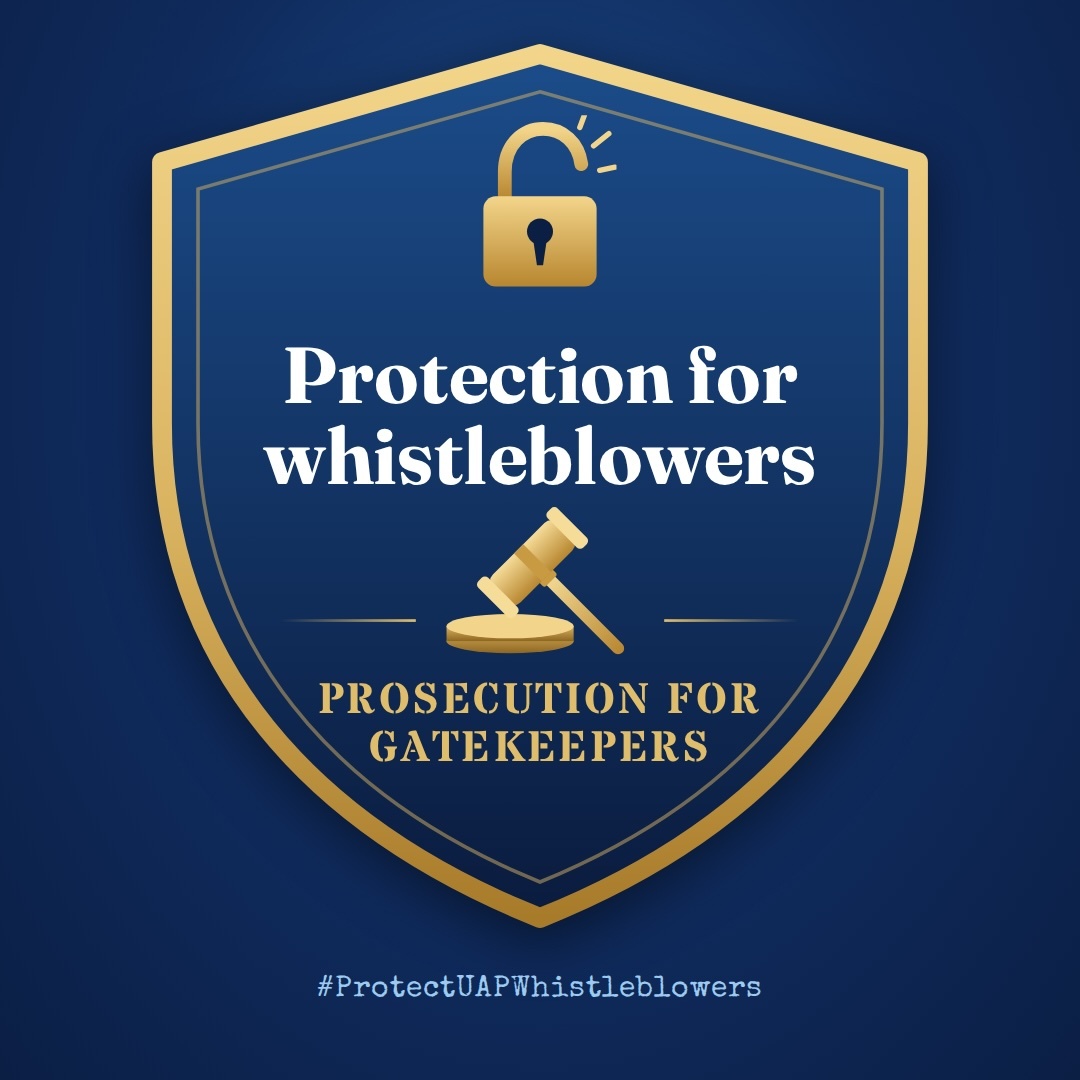
The shield was created by Paolo Guizzardi and is released under a Creative Commons BY-NC-ND license: you are free to share it with attribution, but not for commercial purposes and without modifying it.
Versions: 04/10/2026
Sources
- Wikipedia – David Grusch UFO whistleblower claims
- House Oversight Committee – Hearing "Unidentified Anomalous Phenomena: Exposing the Truth", November 13, 2024 (Elizondo, Gallaudet, Gold, Shellenberger)
- DefenseScoop – Military whistleblowers share new evidence of alleged UAP at transparency hearing
- Stars and Stripes – The September 9, 2025 hearing and the reprisals reported by Dylan Borland
- The Debrief – Pentagon Opens New Pathway for Government Insiders to Disclose UAP Information
- PaoloG's website – The UAP Whistleblowers' Hall of Fame