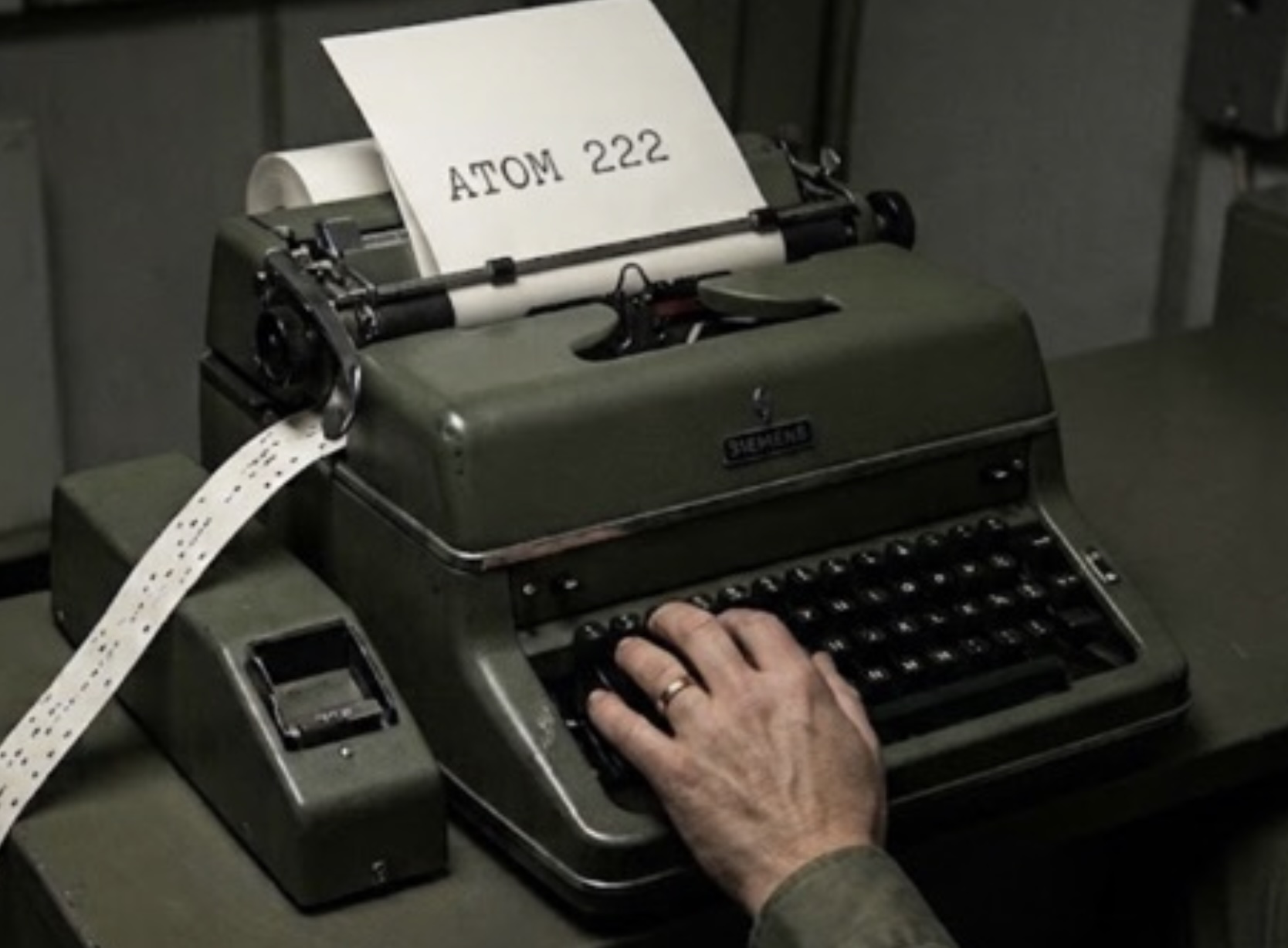
ATOM 222
The secret Hotline message for “unidentified objects” between Washington and Moscow

QUESTO ARTICOLO HA UNA VERSIONE IN ITALIANO

ESTE ARTÍCULO TIENE UNA VERSIÓN EN CASTELLANO

AI-generated image
No, I haven't switched genres to writing geopolitical thrillers. This time I am dealing with a very concrete issue, one that links the UFO phenomenon to the risks posed by nuclear weapons.
In 1971 the United States and the Soviet Union signed an agreement to prevent an accident, an error or an unexplained event from triggering a nuclear war. The agreement essentially set out principles.
In 1976 the two countries gave concrete form to those principles, agreeing on a set of coded messages to be sent over the “Hotline”, the direct communications link between them, should unforeseen situations arise that could spark a nuclear conflict, so that the danger could be quickly averted.
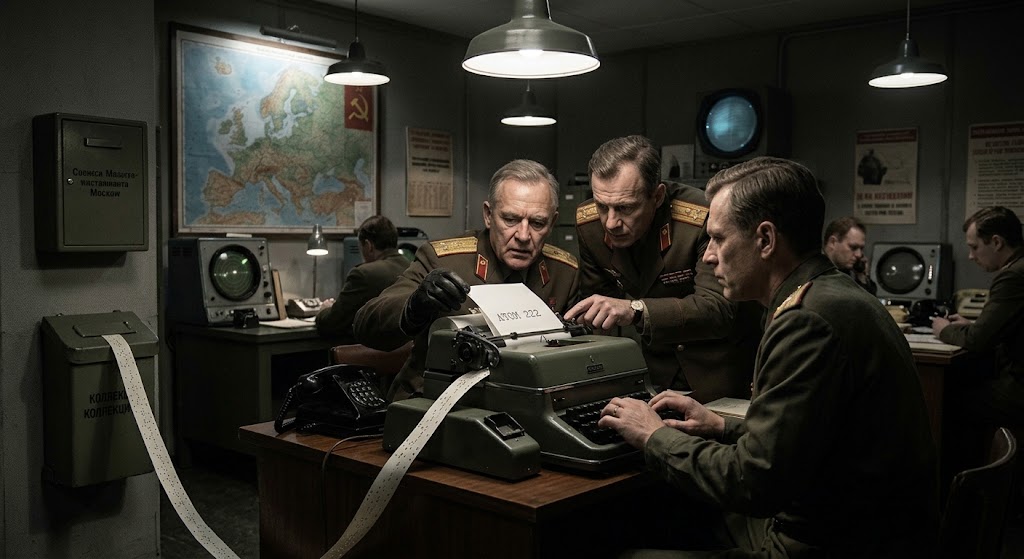
What interests us here is that one of those situations was the appearance of “unidentified objects” on the screens of missile warning systems. In that case, the coded message to be transmitted was ATOM 222.
All this is revealed by a declassified document, published by the National Security Archive, which remained secret for almost forty years and has gone largely unnoticed. It is a memorandum classified SECRET in which the US Secretary of Defense explained to the White House, at the request of the Assistant to the President for National Security Affairs, how Washington and Moscow could communicate in times of crisis. I have just published its full Italian translation on my website.
Attached to the memorandum is its most interesting part: the Protocol of 30 September 1976, signed in Geneva, which assigns a specific code to each of the emergency situations that could drag the two superpowers into a nuclear war.
To understand how that code came about, we need to go back fourteen years.
1962-1963: after Cuba, the “Hotline”
In October 1962 the Cuban Missile Crisis revealed a terrifying truth to the world: the two nuclear powers had no fast, direct way of talking to each other. Messages between Kennedy and Khrushchev went through the embassies and took hours to reach their destination, more than enough time to slide into nuclear apocalypse.
The answer came on 20 June 1963, when representatives of the two countries signed in Geneva the memorandum of understanding establishing the Direct Communications Link, which the world would come to know as the “Hotline”. Contrary to popular belief, it was not a telephone but a pair of teleprinters connected by a cable circuit running through London, Copenhagen, Stockholm and Helsinki, with a backup radio circuit via Tangier. The United States used the link during the 1967 Six-Day War, to prevent Moscow from misreading the movements of the Sixth Fleet in the Mediterranean, and again during the 1973 Arab-Israeli war.
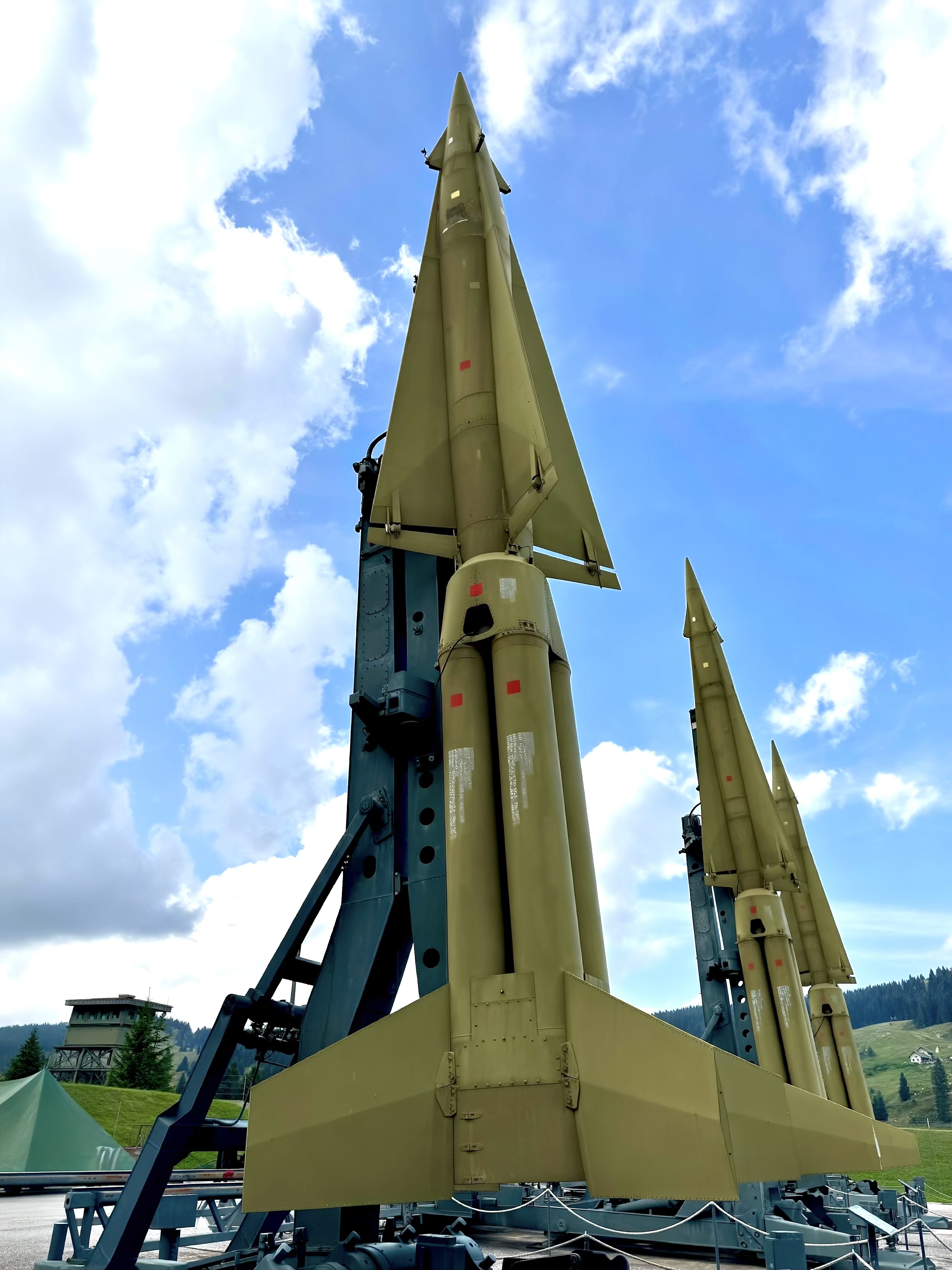
Nike Hercules missiles at Base Tuono, Passo Coe, Folgaria (Trento, Italy), the only Cold War NATO missile base preserved in Italy (photo by the author)
1971: the Accident Measures Agreement and Article 3
In the early 1970s, within the SALT negotiations on the limitation of strategic arms, the two delegations set up two special working groups: one on the risk of accidental war, the other on upgrading the Hotline. The outcome was two agreements signed on the same day, 30 September 1971, in Washington.
The first is the Agreement on Measures to Reduce the Risk of Outbreak of Nuclear War, signed by Secretary of State William Rogers and Foreign Minister Andrei Gromyko. In nine articles, the Parties undertake to:
- Art. 1: maintain and improve their safeguards against the accidental or unauthorized use of their nuclear weapons.
- Art. 2: notify each other immediately of any accidental, unauthorized or unexplained incident involving a possible detonation of a nuclear weapon.
- Art. 3: notify each other immediately in the event of detection by missile warning systems of unidentified objects, or of signs of interference with these systems or with related communications facilities, if such occurrences could create a risk of nuclear war.
- Art. 4: notify each other in advance of planned missile launches extending beyond national territory in the direction of the other Party.
- Art. 5: act, in the event of unexplained nuclear incidents, so as to reduce the possibility of their actions being misinterpreted.
- Art. 6: make primary use of the Hotline for notifications requiring prompt clarification.
- Art. 7: hold consultations on the implementation of the Agreement and on possible amendments.
The second agreement, signed the same day, modernized the Hotline by adding two satellite circuits: one through the American Intelsat system, the other through the Soviet Molniya system.
Let us pause for a moment to put things in context. In December 1969, less than two years earlier, the US Air Force had closed Project Blue Book, officially declaring that UFOs posed no threat to national security. And yet, in September 1971, the two superpowers put down in black and white, in an international treaty, that unidentified objects detected by missile warning systems could be the spark of a nuclear war. Moreover, a few weeks before Blue Book was closed, a memo by General C. H. Bolender had stated that reports which could affect national security would continue to be handled through the usual classified channels, implying that the cases handled by Blue Book were those of no relevance to national security, in fact the least important ones.
1972: the Standing Consultative Commission
Article 7 of the Agreement provided for periodic consultations on its implementation. Their natural forum became the Standing Consultative Commission (SCC), established by the memorandum of understanding of 21 December 1972 to oversee the implementation of the SALT I agreements, which met in Geneva.
30 September 1976: the Protocol and the ATOM messages
Exactly five years after the Agreement, on 30 September 1976, the work of the Standing Consultative Commission bore fruit: its two commissioners, the American Sidney N. Graybeal and the Soviet Major General G. I. Ustinov, signed in Geneva the Protocol on the Use of Immediate Notifications in Implementation of the Agreement on Measures.
Its stated purpose was the “maximum reduction of transmission time” of the notifications provided for in the 1971 Agreement. The solution was as simple as it was effective: for each of the six emergency situations identified, the Parties agreed in advance on the full text of a message, which each kept at hand, and on a short message made up of the code word ATOM followed by a three-digit number. It was enough to transmit the short message: whoever received it already knew the corresponding full text.
ATOM + one digit repeated three times
(ATOM 111, ATOM 222…)
This detail deserves a moment's attention. The Protocol does not explain why the digit is repeated three times, but the reason seems obvious to anyone who has worked in telecommunications: redundancy reduces the chance of errors. With an ATOM+N format, a single wrong key would have turned one message into another, with potentially catastrophic consequences. With the digit repeated three times, a code received as ATOM 322 or ATOM 33 would immediately have revealed a typing or transmission error, and correcting it would have taken only moments. It is the same principle by which, in maritime communications, distress and urgency signals are repeated three times: SOS SOS SOS in radiotelegraphy, MAYDAY MAYDAY MAYDAY and PAN-PAN PAN-PAN PAN-PAN in radiotelephony.
In this way, on receiving the few characters of “ATOM 222”, the operator at the other end of the line, and above him the political leadership, knew immediately and with certainty what it was about, without waiting for a whole text to be transmitted and translated.
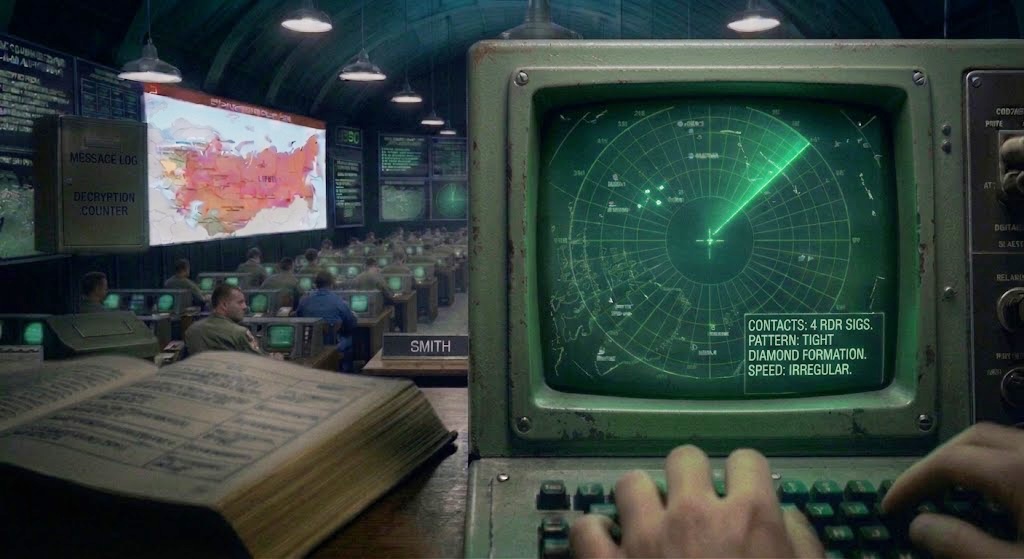
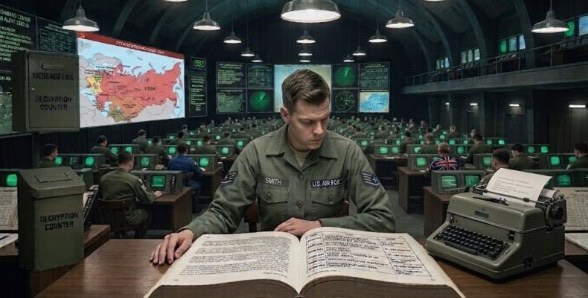
A typical ATOM 222 situation (AI-generated image)
Besides the need to rule out any ambiguity and error, the main reason for this choice was time. Back then, in a nuclear crisis, minutes could avert the apocalypse, and every second spent composing, transmitting and translating a message was a second taken away from the decision. It is the same logic as the venerable Q code of radiotelegraph communications, which I know well, having used it every day during the years I worked as a radiotelegraph operator at the coastal radio station Roma Radio (IAR): instead of wasting time tapping out a whole sentence in Morse, a three-letter group was enough, such as QTH to ask for or give a position, or QRA to ask for or give the name of a ship or aircraft, and anyone, whatever their language, understood instantly.
The ATOM codes follow the same principle. Instead of writing something like “We have detected a series of tracks heading from the Barents Sea towards United States territory: is this one of your exercises, or what is it?”, and then waiting for the message to be translated and understood at the other end of the line, it was enough to transmit ATOM 222. That handful of characters stated in an instant, and with precision, what the situation was and what was being asked of the other side, with no room for ambiguity and no need for translation.
The Protocol entered into force on 30 March 1977 and long remained secret. It was declassified on 15 November 2013, in all likelihood for the first time, when the Jimmy Carter Presidential Library authorized its release in full.
The Pentagon memorandum to which the Protocol is attached describes the Hotline system of the time in detail: the main terminal was in the National Military Command Center (NMCC) at the Pentagon, with an alternate military terminal at Fort Ritchie, Maryland, and a third at the White House; there were also four teleprinter circuits, one via London, one via Rome and two via satellite. Above all, the memorandum stressed the timing: an emergency message approved by the President could reach Moscow within five minutes; an incoming Soviet message was translated in about ten.
The six numerical codes
The Protocol identifies six emergency situations and assigns each its own code.
| Code | Situation | Does the message request clarification? |
|---|---|---|
| ATOM 111 | Accidental, unauthorized or unexplained incident involving a possible detonation of a nuclear weapon | No: “details follow” |
| ATOM 222 | Detection by missile warning systems of unidentified objects | Yes, urgently |
| ATOM 333 | Detection of interference with missile warning systems or related communications facilities | Yes, urgently |
| ATOM 444 | Unsuccessful launch of a missile not carrying a nuclear weapon, whose trajectory extends or may extend beyond national territory | No: “details follow” |
| ATOM 555 | Unexplained nuclear incident, when the notifying Party fears that the other Party’s actions may be misinterpreted | Yes, urgently |
| ATOM 666 | Unexplained nuclear incident, when the notifying Party fears that its own actions may be misinterpreted | No: “details follow” |
AI-generated image
The table reveals a precise logic. Codes 111, 444 and 666 are for those who need to explain something of their own: an incident, a missile gone off course, an action that might be misread. Whoever sends them knows what has happened, informs the other side and promises details. Codes 222, 333 and 555 are instead for those who need to ask: whoever sends them has seen something they cannot explain, and asks the other side whether it knows anything about it. For these three cases, and only for these, paragraph 3 of the Protocol obliges the receiving Party to transmit “urgently” the information at its disposal.
The ATOM 222 code
Let us now take a closer look at the code that concerns us. The situation it refers to is the “detection by missile warning systems of unidentified objects, if such occurrence could create a risk of outbreak of nuclear war between the USA and the USSR”. According to the Protocol, the full text of the message reads as follows:
AI-generated image
Three aspects deserve attention.
The first is the word “our”. Whoever sends ATOM 222 is not accusing the other Party of having launched something. They are admitting that their own radars have seen something their own analysts cannot identify, and they are admitting it to the adversary, at the height of the Cold War. Neither superpower would have agreed on such a message unless it considered the possibility of having to send it one day a concrete one, not merely a theoretical one.
The second is the distinction between ATOM 222 and ATOM 333. The drafters of the Protocol carefully separated unidentified objects from interference with warning systems and communications. Two different codes for two different phenomena: something that is there and nobody knows what it is, and something that disrupts the systems without showing itself. The fact that the 1971 Agreement groups the two phenomena in the same Article 3 suggests, moreover, that they were perceived as somehow related, although interference could also have entirely earthly causes, such as electronic jamming by the adversary.
The third is the obligation to respond. Just as the principles of the 1971 Agreement were no mere stylistic exercise, ATOM 222 is no mere courtesy notice. It is a formal question, which the Protocol requires the other Party to answer urgently, sharing what it knows. In practice, the two superpowers committed to telling each other, within minutes, whether or not an object that had appeared on one side’s radars was “theirs”.
One might object that “unidentified objects” does not necessarily mean UFOs in the sense ufologists give the word: an object is unidentified until it is identified, whether it turns out to be a re-entering rocket stage, an atmospheric phenomenon or a radar anomaly. True, and that is precisely the point. The document shows that, at the height of public ridicule of UFOs, the military leadership of both superpowers considered unidentified objects frequent enough and, at least potentially, dangerous enough to deserve a dedicated code and an operating procedure with an obligation to respond urgently.
It should also be noted that the expression “unidentified objects”, however generic, points to a concrete situation of which the two superpowers evidently must have been well aware.
An agreement like this, designed to prevent nuclear apocalypse, is not negotiated over figments of the imagination: if two superpowers sat down at a table to decide what to do when their radars detected “unidentified objects”, it is because they had already seen those objects, real though unidentified, and knew they would show up again.
Of course, some of those cases had entirely earthly explanations. On 5 October 1960 the BMEWS early warning radar at Thule, Greenland, mistook the rising Moon for a Soviet missile attack; on 23 May 1967 a violent solar storm blinded the BMEWS radars, and the US Air Force came within a hair of reacting as if to a hostile act.
But ATOM 222 was not designed for “radar junk”. Faults, disturbances and interference, such as those caused by the 1967 solar storm, have a code of their own, ATOM 333. ATOM 222 speaks instead of objects: physical bodies, tracked by radar, moving through airspace, about which it makes sense to ask the adversary “is it yours?”. Nobody would have asked Moscow whether the Moon or shooting stars were “theirs”. ATOM 222 concerned precisely that well-defined category of real objects that the systems detected without being able to identify them.
That the danger was real is also shown by the false alarms documented by the National Security Archive itself, in the same briefing book in which this document was published. On 3 October 1979 the Mount Hebo radar in Oregon reported a missile launched from a submarine off the West Coast; a Senate report later attributed the radar return to a re-entering rocket body in orbital decay.
On 9 November 1979 NORAD screens showed the tracks of 1,400 Soviet intercontinental missiles launched towards the United States: it was an exercise tape loaded by mistake, and the alarm was recognized as false in less than six minutes, but in the meantime several elements of the strategic air defense had already been activated. In June 1980 a faulty integrated circuit produced two more false alarms. In all these cases the problem was always the same: understanding quickly what the systems were showing.
Things were no better on the other side of the Iron Curtain. Shortly after midnight on 26 September 1983, at one of the tensest moments of the Cold War, Lieutenant Colonel Stanislav Petrov was on duty in a bunker outside Moscow that received data from the new Soviet early warning satellite system, Oko. The system reported the launch of five US ballistic missiles heading for the USSR. Petrov found it strange that an American first strike should consist of only five missiles; he had little faith in the newly installed system, and he noticed that ground radars were confirming nothing. Judging the alarm to be false, he decided, with great courage, not to pass it up the chain of command, which in such a case could have ordered retaliation. After minutes of agonizing waiting, his intuition was confirmed: no missile arrived. It was later discovered that the satellite had mistaken sunlight reflecting off the tops of clouds for missile launches, and that the software meant to filter it out had failed.
Even more instructive, for our purposes, is what happened on 25 January 1995, after the end of the Cold War. That morning a Black Brant scientific rocket for atmospheric research was launched from Andøya, in northern Norway, towards Svalbard. Russian radars detected it immediately and did not classify it as a civilian sounding rocket. President Yeltsin later declared that he had used his nuclear briefcase, the Cheget, for the first time, consulting the Defense Minister and the top military leadership; other Russian sources later played the episode down. The crucial detail is another: Norway had duly notified the launch, with a letter of 21 December 1994 and a further notice on 16 January 1995. But that notification, for reasons never fully clarified, had never reached the radar operators. A notification that does not reach the person watching the screen is as good as one never sent, and that is precisely why the 1976 Protocol had insisted on short, direct and unambiguous messages.
Today: hypersonic missiles and the time we no longer have
In 1976 an emergency message took five minutes to travel from Washington to Moscow, and decision makers had a good half hour ahead of them, the flight time of an intercontinental ballistic missile, whose trajectory, moreover, was predictable.
Today hypersonic missiles have radically changed this picture. They travel at more than five times the speed of sound, fly at lower altitudes and, above all, are able to maneuver in flight, changing direction unpredictably. They are hard to detect, track and intercept, and whoever sees them coming has no way of knowing whether they carry a conventional or a nuclear warhead. According to a Project Ploughshares analysis of November 2025, warning time could soon drop below ten minutes.
Now read this description alongside that of many UFOs/UAPs reported by military pilots and radar operators over the last eighty years: extreme speeds, unusual altitudes, sudden non-ballistic changes of direction. The resemblance is obvious, and dangerous in both directions. A UAP, or a formation of UAPs, can be mistaken for an incoming hypersonic attack. And a hypersonic missile can pass, for the first precious minutes, for one of the many “unidentified objects” that surveillance systems routinely record. I discussed this topic in my article of 10 November 2022, Hypersonic missiles and UAPs: dangerous similarities, and what I wrote then is even more valid today.
In this scenario the ATOM 222 question, “is it yours?”, would be needed more than ever, but it is becoming ever harder to ask it in time. Time has been eroded by hypersonic weapons. Mutual trust is in short supply: on 5 February 2026 the New START treaty expired without being replaced. And the world is no longer bipolar: there are nine nuclear powers, while the 1963 Hotline connected only Washington and Moscow. With such short timeframes comes the growing temptation to entrust part of the decision chain to automated systems and artificial intelligence. That is precisely what a 21st-century ATOM 222, instantaneous, multilateral and able to share data in real time, should help to avoid.
In 1976 two irreconcilable adversaries managed to agree, in secret, on an elementary fact: when the radars show something nobody can explain, the first thing to do is not to shoot, but to ask. That lesson is more relevant today than ever.
I would like to close this article by repeating the conclusion of my previous article, which becomes ever more urgent as the quantity and destructive power of the weapons available to the powers of our planet keep growing.
There is an urgent need for diplomatic action to reach agreements aimed at mitigating the risk to global security posed by the proliferation of hypersonic weapons and, as happened in 1971, there is a need to include the UAP phenomenon in the equation.
At the same time, an open, international scientific study of the phenomenon must be launched, because in such a potentially dangerous situation it is more important than ever to know as much as possible about it. In particular, such studies should focus on developing a way to reliably distinguish manifestations of the UAP phenomenon from hypersonic missiles.
Paolo Guizzardi
The original document (the Secretary of Defense memorandum, the annex on Hotline procedures and the Protocol) is available from the National Security Archive. For Italian-speaking readers, my full Italian translation is in record VAR-040 on my website.
Versions: 24/10/2026
Sources
- National Security Archive – Document 3: Secretary of Defense memorandum with the Protocol of 30 September 1976
- National Security Archive – Colonel Odom’s “Chilling” Four A.M. Phone Call (24 March 2022)
- Avalon Project (Yale Law School) – Text of the 1971 Agreement
- Federation of American Scientists – The 1971 Accident Measures Agreement
- Federation of American Scientists – The Hotline: from the 1963 memorandum to its upgrades
- Federation of American Scientists – Standing Consultative Commission Regulations
- Union of Concerned Scientists – The Moon and Nuclear War (the 1960 Thule false alarm)
- University of Colorado Boulder – 1967 solar storm nearly took U.S. to brink of war (9 August 2016)
- RFE/RL – Stanislav Petrov and the false alarm of 26 September 1983
- Bulletin of the Atomic Scientists – What this Norwegian “close call” says about a world without New START (13 April 2026)
- Project Ploughshares – Philip Carrey, Speed Over Certainty (November 2025)
- Military.com – After New START: why the end of US-Russia nuclear limits matters (6 February 2026)